

/v3/router/batches. Batch requests, response objects, status values, and result files follow the OpenAI batch format, with Orq.ai additions for the endpoint list, listing filters, and project scoping.
Provider batches run against models that declare batch support for the endpoint and are priced at the provider’s batch rates. Check batch support for a model on the Models page.
Supported endpoints
Provider batches run through the provider’s batch service. Decisions batches run on Orq.ai workers, which pace the lines and check budgets per line.
The OpenAI SDK type definitions declare
/v1/responses, /v1/chat/completions, /v1/embeddings, and /v1/completions. Send /v1/moderations and /v3/router/decisions with the HTTP API.
Run a batch
Create a batch from the console or the API.- AI Studio
- API & SDK
 AI Studio
- Open Batches under AI Gateway. The list shows one row per batch with its ID, status, model, endpoint, request counts, and creation time.
- Click Batch.
- Choose the JSONL file, pick the endpoint, add metadata when needed, and click Create batch. The completion window is
24hand the field is not editable. - Follow the request counts, files, and status timeline in the list or the batch detail drawer. Filter by Status and Endpoint, or search by batch ID, model, or endpoint.
- Download the results once the batch finishes: the drawer footer shows Download results, and Download errors beside it when the batch produced an error file, or on its own when the batch produced no output file. Cancel a running batch from the row actions or the detail drawer.
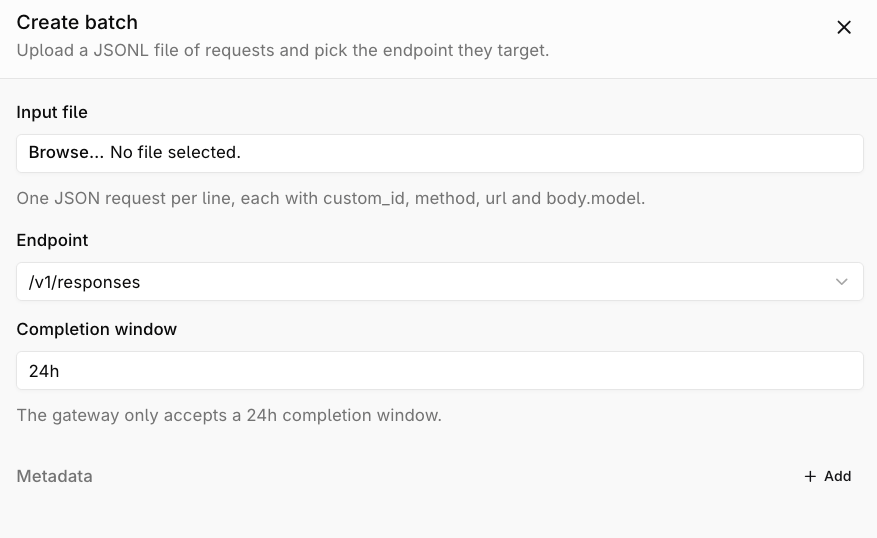
Create a batch from the Batches screen.
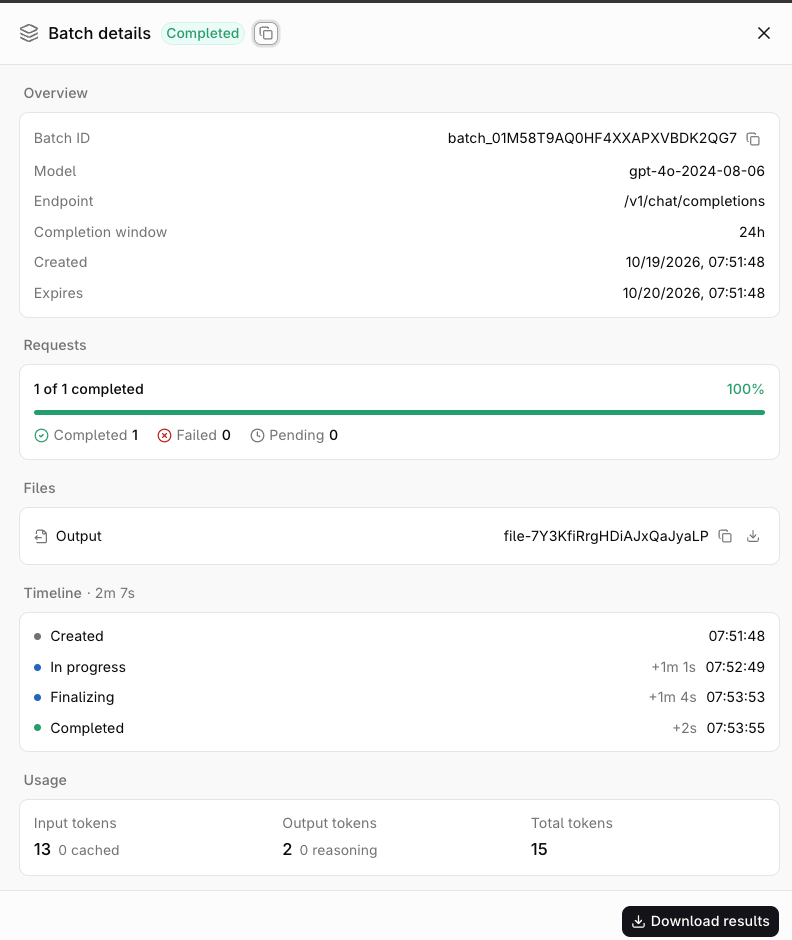
Batch details drawer with request progress, files, and the status timeline.
Failed, cancelled and expired batches
A batch that endscancelled or expired keeps the results of the lines that ran, in the output file.
- Cancelled: lines that had not started appear in the errors file with
custom_idand an error, so they can be matched back to the input file. - Expired: lines that did not run before the 24-hour window appear in the errors file with
batch_expired. - Billed lines: usage comes from the provider’s counts when the batch reaches its terminal state, so a cancelled or expired batch bills the lines the provider reports as run.
- Rerunning a subset: the errors file carries
custom_idand the error only. Build the new JSONL from the original file by keeping the lines whosecustom_idappears in the errors file, and submit that as a new batch.
Input file
Each line follows the OpenAI batch input format.
Limits apply to the whole file and to each line.
A file that exceeds a limit fails the create call with
400 and an invalid_request error: Input file with id … exceeds maximum size of … bytes or input file exceeds maximum line count (100000). Both paths cap a line at 20 MiB. A classify batch (/v3/router/decisions) rejects a longer line with input file has a line longer than … bytes; a provider batch create fails with the generic read-input error instead.
All lines in a provider batch must resolve to the same provider, and each model must declare batch support for the endpoint. Lines can use different models only when they share a provider and support the endpoint.
Batch statuses
List and filter batches
GET /v3/router/batches returns batches in the caller’s projects, newest first.
list method sends limit and after. Send before, status, endpoint, and search over the HTTP API:
cURL
JSON
Results
Each result line follows the OpenAI batch output format.response.body is the endpoint response for that line. response.request_id is the provider’s response identifier for a provider batch, and the trace ID of the line for a Decisions batch.
A provider batch records one trace for the whole batch when it reaches a terminal state, so look it up by the batch ID: the trace carries orq.batch.id. A Decisions batch traces each line separately, and that trace ID is the line’s request_id.
JSON
error object instead of a response:
JSON
Provider batches can also return provider-specific error codes for lines the provider rejected.
Both files download from
GET /v3/router/batches/{batch_id}/results, as shown in the download step under Run a batch: the output file by default, the error file with ?file=errors.
Behaviour
- Validation up front: every line is checked before the batch is created, including the model and its access checks. An invalid line rejects the whole file with
400and names the line. - Tracing and billing: a provider batch records one trace with the batch’s aggregate usage when it reaches a terminal state, priced at the provider’s batch rates. A Decisions batch runs on Orq.ai workers, and each line is traced and billed like a single request.
- Budgets: Decisions batches check budgets per line. A line that hits a cost or token budget fails with
429in its result; a requests-per-minute budget delays the line for up to two minutes before failing it. - Project scoping: a batch belongs to the project of its input file. List, retrieve, download, and cancel only reach batches in the caller’s projects.
- Permissions: the API key needs the
batchespermission. A Decisions batch also needs theclassifypermission. - Rate limits: creating a batch counts as one request against plan rate limits. See Rate limits and quotas.
- Cancel:
POST /v3/router/batches/{batch_id}/cancelstops the lines that have not run. Calling it on a terminal batch returns the stored batch unchanged.
Related
Files API
Upload the JSONL input file with the batch purpose.
Decisions
Batch classification requests against a Decisions model.
Background Responses
Run a single long-running response without batching.