

trace_scrubbing plugin selects what the AI Gateway writes to stored traces. It changes only the stored copy, never the live request, the response, or the payload the provider receives. See Trace Data Masking for the per-request security field, which feeds the same masking.
Use cases
- Keeping prompt content, model output, or template variables out of trace storage without changing what the model receives.
- Retaining latency, token, and cost data on a trace while removing the text that produced it.
- Enforcing one masking policy across a workspace instead of adding
security.maskto each call, on the routes listed under Supported endpoints.
Comparison to Trace Data Masking
Trace Scrubbing (this page) and Trace Data Masking both decide what the AI Gateway writes to a stored trace. They mask the same fields with the same code, so what differs is not what gets masked but where the mask is set and who can change it. What is the same- Both accept
input,output,system,metadata,variables, orall. - Both blank or remove those fields from the stored trace only. The live request, the response, the payload the provider receives, and the data Guardrails and Evaluators check are untouched.
- A request that sends both is merged: the masks add up, and neither side removes a mask the other set.
Which to use:
security.mask suits a caller protecting its own traffic, at the cost of sending the field on every request. trace_scrubbing suits a policy that must hold for everyone, because an admin sets it once for the workspace, a rule, or a gateway and no caller can opt out.
Quick start
Add atrace_scrubbing entry to the plugins array with at least one mask value.
mask value: a routing-rule or MCP-gateway placement rejects an entry with none. A request-scoped entry with no values is accepted by the runtime and masks nothing. The What each value masks table lists the accepted values and what each one removes from a stored trace.
Enable for a workspace
Turn on Trace Scrubbing under Settings > Plugins to apply a mask to every request, without passing aplugins array on each call. Once the toggle is on, a icon appears next to it; click it to choose the surfaces to mask. Enabling the plugin without choosing any masks everything.
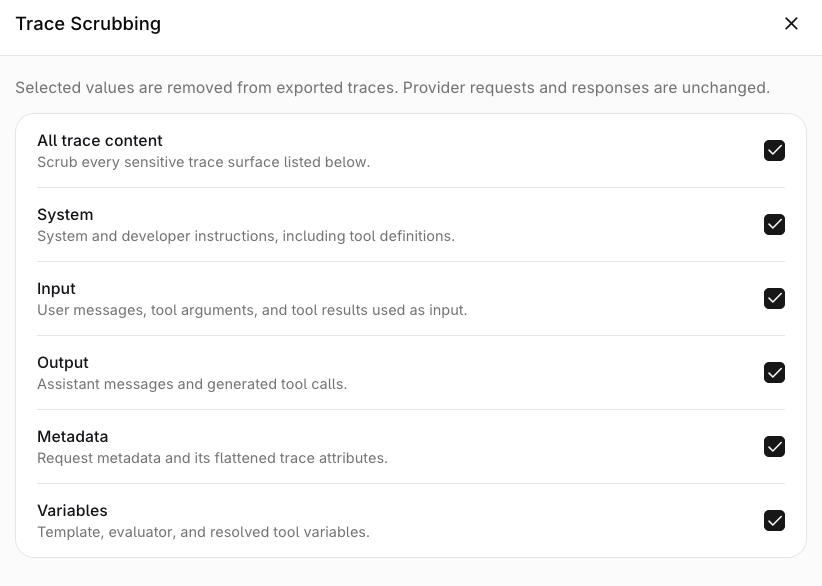
The Trace Scrubbing configuration panel, with every trace surface selected.
all wins over any narrower selection, so a request can mask more but never less. This matches how workspace-level PII redaction behaves.
Apply per routing rule
Attach Trace Scrubbing to a routing rule to mask traffic that matches the rule, with the fields chosen on the rule. An MCP gateway takes the same plugin for the tool-call traces it stores.What it does not do
- It does not remove anything from the live request or response, or from the payload the provider receives.
- It does not change the data an Evaluator or Guardrail processes: the check still receives the original runtime input, output, instructions, and variables, and only the persisted span is scrubbed. See Trace scrubbing and evaluator data.
- It does not redact PII before the provider sees it. Use PII Redaction for that.
Scrubbing removes the masked values from the stored trace rather than hiding them from view, so the request cannot be debugged from those fields afterwards. Where diagnosis matters, keep an unsanitised copy elsewhere or narrow the mask to the fields that must not be stored.
Supported endpoints
Theplugins entry is accepted on the same endpoints as the other plugins; see Supported endpoints. The workspace setting and a routing-rule attachment reach further: their mask is written to the stored trace of a request whose handler records masking options, including deployment invokes and /classify, plus the tool-call traces an MCP gateway stores. A route that records none is never scrubbed, whatever the placement: images/edits, moderations, and the /responses WebSocket and /responses/compact routes.